
For high-hazard industrial environments containing volatile chemicals, pressurized gasses, and heavy electrical apparatuses, standard fire sprinkler systems are insufficient. These high-risk assets demand an engineered, high-velocity cooling and suppression mechanism designed to mitigate rapid thermal escalation and prevent catastrophic structural collapse or explosions.
DeFire USA designs, installs, and services heavy-duty Water Spray Fixed Systems fully compliant with NFPA 15 standards. Unlike traditional fire sprinklers that protect an entire room or building footprint, water spray systems are highly specialized, directionally targeted solutions engineered to protect specific, critical industrial components.
Water spray fixed systems operate on a deluge principle—utilizing open, unpressurized nozzles connected to a piping network controlled by a central detection-activated deluge valve. Upon system actuation, water discharges simultaneously from all nozzles to achieve three primary safety objectives
When adjacent assets are threatened by intense radiant heat, the system applies a continuous, uniform film of water over the unignited structures. This keeps metal temperatures below critical failure thresholds, preventing structural deformation or pressurized tank explosions (BLEVEs).
Open nozzles are mathematically placed and directionally oriented to discharge water directly onto the surface of the burning hazard, breaking the fire tetrahedron through rapid heat absorption.
The high-velocity spray pattern assists in safely dispersing and diluting heavy flammable vapors or toxic gas clouds, reducing the risk of secondary explosions.
Water spray fixed systems are engineered for industrial processes where fire propagation happens in milliseconds. DeFire USA provides custom turnkey configurations across key high-hazard sectors:
Spherical storage tanks (LPG/LNG), bulk fuel loading racks, and petrochemical process structures.
Provides continuous, targeted surface cooling to large vessel exteriors, preventing catastrophic structural failure and pressure ruptures during an active industrial fire.
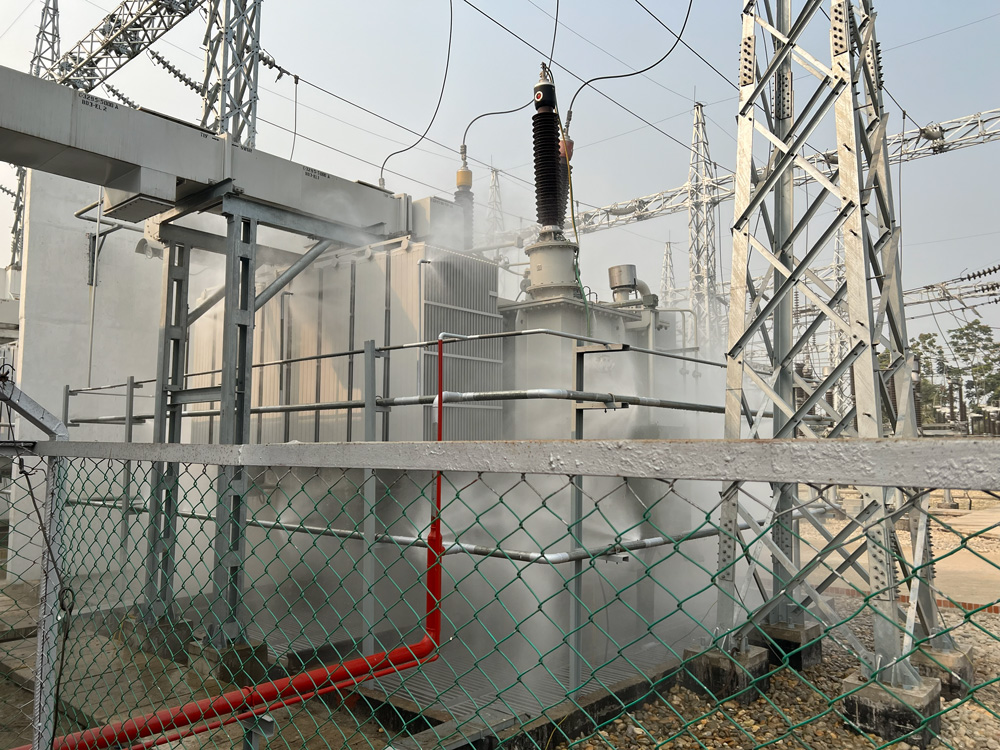
High-voltage electrical transformers, oil-insulated switchgear, and cable runs.
Designed using specialized directional nozzles to extinguish intense oil fires safely, keeping water patterns precise to prevent arc flash propagation to adjacent energized equipment.
Coal conveyors, biomass handling, and heavy industrial manufacturing transit lines.
Suppresses fast-moving linear fires along exposed transport belts, preventing the fire from tracking deep into processing plants or silos.
| Target Hazard Asset | Primary Engineering Objective | Critical NFPA 15 Design Feature |
|---|---|---|
| Flashing Liquid / Gas Tanks | Exposure Protection & Vapor Dilution | Continuous, uniform external envelope cooling to prevent BLEVEs. |
| Large Power Transformers | Class B Insulating Oil Extinguishment | Precision nozzle placement to wrap around complex structural fins. |
| Chemical Process Vessels | Structural Integrity & Fire Control | High-velocity directional spray to penetrate fierce thermal plumes. |
| Hazardous Piping Racks | Thermal Shielding & Isolation | Multi-level spray rings to isolate interconnected process lines. |
Because water spray fixed systems handle highly volatile hazards, there is zero room for error. Designing these systems requires advanced hydraulic calculations, precise calculation of water density requirements (GPM/FT^2), and complex nozzle orientation layouts to combat wind drift and geometric obstructions.
At DeFire USA, our industrial fire protection engineers possess the advanced technical training required to design, install, and commission robust, code-compliant NFPA 15 systems. We ensure your high-value industrial assets remain operational, protected, and fully compliant with global insurance underwriting standards.